About
I work where people are overloaded and the next step is not obvious.
My background is in Applied Cognition and Neuroscience, with a specialization in Cognition (2026). I am interested in the moments where people are overloaded, uncertain, transitioning between tasks, or trying to act on fragmented information. The same cognitive principles show up in a NICU room, a planning app, a sizing decision, a game tutorial, or a financial decision: people are trying to act with incomplete information, limited attention, and real consequences.
Based in Dallas-Fort Worth. Open to on-site, hybrid, and remote roles.
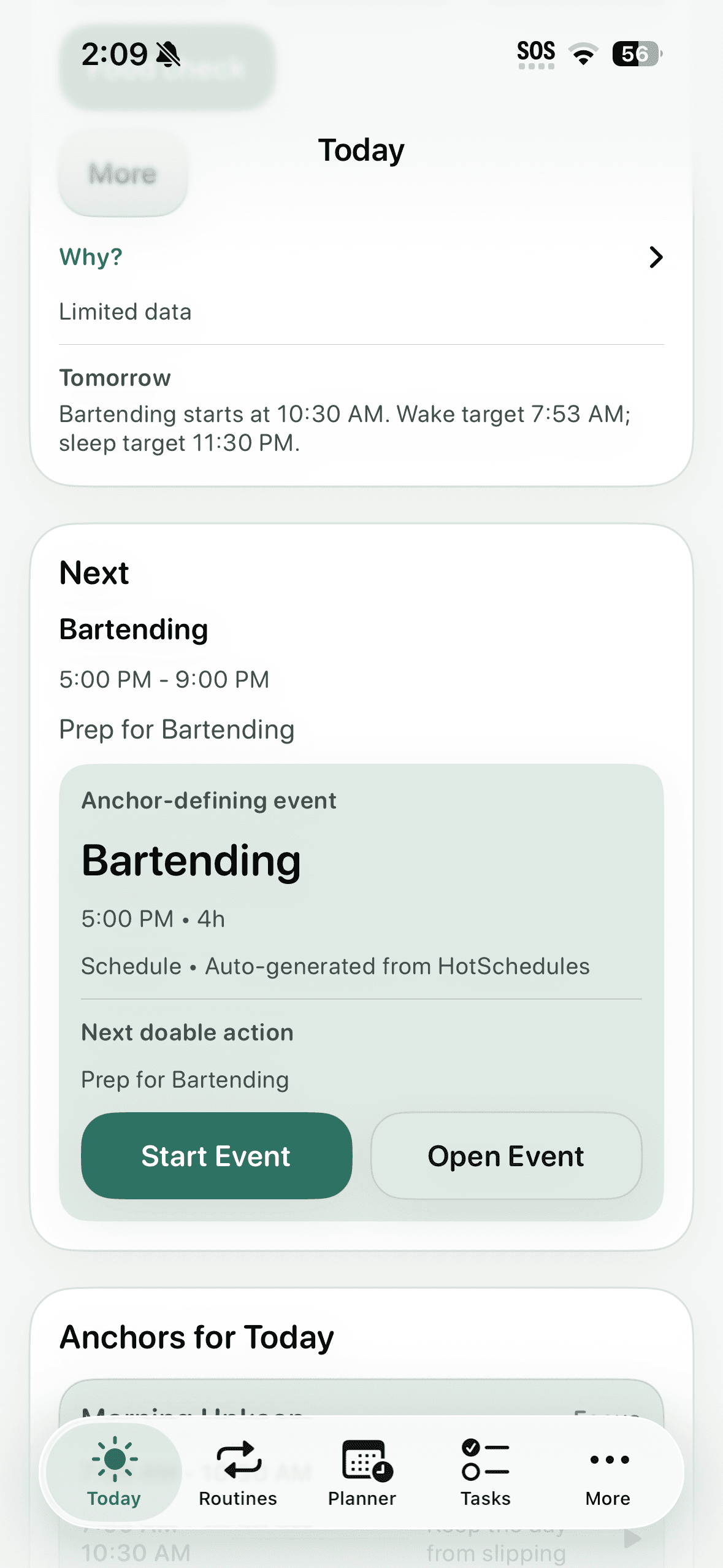

Systems thinking came before the interface.
Graduate work, behavioral research, bartending and restaurant management, and design work have all shaped how I work: people rarely make decisions under perfect conditions. They are tired, interrupted, missing context, and trying to recover from friction while still moving forward.
That is why my work focuses on cognitive systems, adaptive support, and decision-heavy experiences. I am less interested in adding screens than in designing structures that help people understand what changed, what matters now, and what to do next.
That systems-first approach also shapes how I use AI. I use agents as research partners, implementation partners, and critique layers, while I stay responsible for deciding what is accurate, useful, and right for the user.
The projects span healthcare, productivity, retail, and games, but the underlying question is consistent: how should a system support people when context is fragmented, stakes are real, and the next action is not obvious?
I do my best work where that question is the job: helping people, whether customers, patients, study participants, users, or a team, get from confusion to a clear next action. I learn unfamiliar technical and domain material quickly so I can do that well.
Next